Introduction
The foreign exchange market, commonly known as Forex or FX, is the world’s largest financial market. Every day, trillions of dollars are exchanged between banks, governments, multinational corporations, institutional investors, and retail traders.
Unlike stock markets, Forex operates 24 hours a day, five days a week, making it one of the most accessible and liquid markets available to traders worldwide.
Whether you’re interested in trading currencies for profit or simply want to understand how the global financial system works, this guide will help you learn the fundamentals of Forex trading.
What Is Forex?
Forex stands for Foreign Exchange and refers to the process of exchanging one currency for another.
For example:
- Converting U.S. Dollars (USD) into Euros (EUR)
- Exchanging British Pounds (GBP) for Japanese Yen (JPY)
- Trading Australian Dollars (AUD) against U.S. Dollars (USD)
The Forex market enables international trade, tourism, investment, and global commerce.
When traders participate in Forex, they aim to profit from changes in currency exchange rates.
How Does Forex Trading Work?
Currencies are always traded in pairs.
Some of the most popular currency pairs include:
| Currency Pair | Description |
|---|---|
| EUR/USD | Euro vs U.S. Dollar |
| GBP/USD | British Pound vs U.S. Dollar |
| USD/JPY | U.S. Dollar vs Japanese Yen |
| AUD/USD | Australian Dollar vs U.S. Dollar |
| USD/CAD | U.S. Dollar vs Canadian Dollar |
When you buy a currency pair, you expect the first currency (base currency) to increase in value relative to the second currency (quote currency).
Example
If you buy EUR/USD at 1.1000 and the price rises to 1.1100, you may profit from the increase.
If the price falls instead, your position may result in a loss.
Why Is Forex So Popular?
Forex attracts millions of traders worldwide for several reasons.
High Liquidity
The Forex market has enormous trading volume, allowing traders to enter and exit positions quickly.
24-Hour Trading
Forex operates continuously from Monday through Friday, enabling traders to participate from nearly any time zone.
Low Barrier to Entry
Many brokers allow traders to start with relatively small account balances.
Opportunity in Rising and Falling Markets
Traders can potentially profit whether currencies move up or down.
Global Accessibility
Anyone with an internet connection can access the market through an online trading platform.
Who Participates in the Forex Market?
Central Banks
Central banks influence currency values through monetary policy decisions, interest rates, and market interventions.
Examples include:
- Federal Reserve
- European Central Bank
Commercial Banks
Large banks facilitate international transactions and currency exchanges.
Multinational Corporations
Global companies exchange currencies to conduct international business operations.
Hedge Funds and Institutions
Institutional investors trade currencies for speculation, hedging, and portfolio management.
Retail Traders
Individual traders participate through online brokerage platforms.
What Causes Currency Prices to Move?
Several factors influence currency exchange rates.
Interest Rates
Higher interest rates often attract foreign investment, increasing demand for a currency.
Economic Indicators
Key reports include:
- Gross Domestic Product (GDP)
- Inflation Data
- Employment Reports
- Consumer Spending
- Manufacturing Activity
Political Events
Elections, government policies, and geopolitical tensions can significantly affect currency prices.
Market Sentiment
Trader expectations and investor confidence often drive short-term price movements.
What Is a Pip?
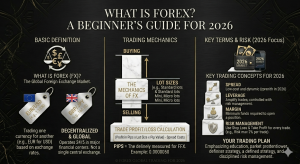
A pip (Percentage in Point) is the standard unit used to measure price movement in Forex.
Example
EUR/USD:
- 1.1000
- 1.1001
The difference is one pip.
Pips are used to calculate profits, losses, and risk exposure.
What Is a Lot?
A lot represents the size of a Forex trade.
Standard Lot
100,000 units of the base currency.
Mini Lot
10,000 units.
Micro Lot
1,000 units.
Many beginner traders start with micro lots to manage risk more effectively.
What Is Leverage?
Leverage allows traders to control larger positions using a smaller amount of capital.
Example
With 1:100 leverage:
- Account Balance: $100
- Market Exposure: $10,000
While leverage can increase potential profits, it can also magnify losses. Proper risk management is essential when trading with leverage.
Major Forex Trading Sessions
The Forex market is divided into three major trading sessions.
Asian Session
Main Financial Centers:
- Tokyo
- Sydney
Generally characterized by lower volatility.
European Session
Main Financial Center:
- London
One of the most active trading periods.
North American Session
Main Financial Center:
- New York
Known for strong liquidity and major economic announcements.
The overlap between the London and New York sessions is often considered the most active trading period of the day.
Advantages of Forex Trading
✅ Largest financial market in the world
✅ High liquidity
✅ 24-hour market access
✅ Ability to trade both long and short
✅ Low entry requirements
✅ Wide variety of trading opportunities
Risks of Forex Trading
⚠️ High leverage can increase losses
⚠️ Market volatility can be unpredictable
⚠️ Emotional decision-making can lead to poor results
⚠️ Lack of risk management may damage trading accounts
⚠️ No strategy guarantees profits
Every trader should understand the risks before investing real money.
How to Start Trading Forex
1. Learn the Basics
Understand:
- Currency pairs
- Pips
- Lots
- Leverage
- Risk management
2. Open a Demo Account
Practice trading without risking real money.
3. Develop a Trading Plan
Create clear rules for entering and exiting trades.
4. Keep a Trading Journal
Track your performance and learn from your mistakes.
5. Focus on Risk Management
Professional traders prioritize capital preservation over short-term gains.
Frequently Asked Questions
Is Forex Trading Legal?
Forex trading is legal in many countries when conducted through properly regulated brokers. Always verify local regulations before opening an account.
How Much Money Do I Need to Start?
Many brokers allow accounts with low minimum deposits. However, beginners should only trade with money they can afford to lose.
Can You Make a Living Trading Forex?
Some professional traders generate consistent income from Forex trading, but achieving long-term success requires education, discipline, and experience.
Is Forex a Guaranteed Investment?
No. Forex trading involves substantial risk, and losses can occur.
Final Thoughts
Forex is the largest and most liquid financial market in the world, offering opportunities for traders of all experience levels. However, successful trading requires knowledge, discipline, patience, and effective risk management.
Before risking real capital, take time to learn the fundamentals, practice on a demo account, and develop a structured trading plan.
Building skills and experience is the foundation of long-term success in the Forex market.
Disclaimer
The information provided in this article is for educational purposes only and should not be considered financial, investment, or trading advice. Trading Forex involves significant risk and may not be suitable for all investors. Always conduct your own research before making financial decisions.